
About the Picture
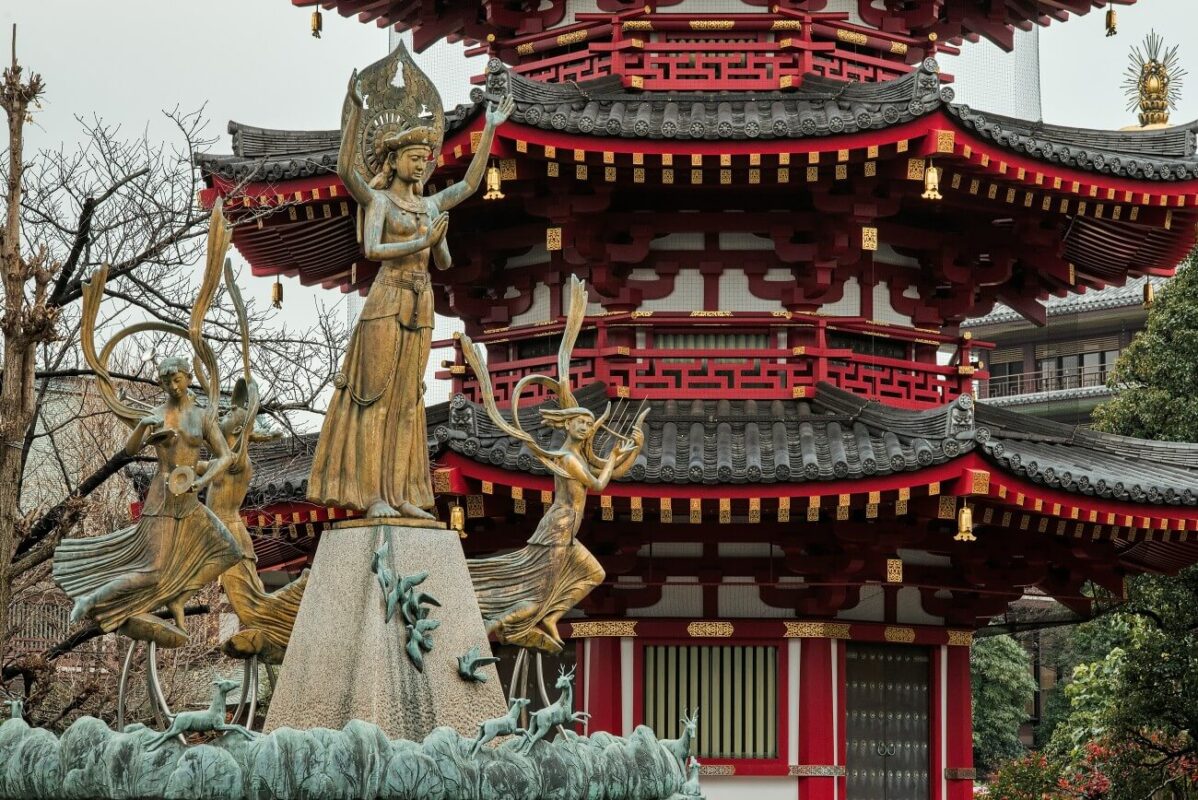
When visiting Kawasaki Daishi (Heiken-ji Temple), you will find many beautiful sculptures, monuments and temple details around the grounds. Here, I’m sharing two of them in one picture – the “Prayer and Peace” statue and part of the octagonal five-storied pagoda, a rare view in Japan.
But before we look closely at what is in the picture, let’s first look at why Kawasaki Daishi is special — and why this hidden gem near Tokyo may be worth adding to your Japan itinerary.
Kawasaki Daishi is not just a neighborhood temple in Kawasaki. It is a major Buddhist site formally known as Kongosan Kinjoin Heikenji, commonly called Kawasaki Daishi, and it belongs to the Chisan School of Shingon Buddhism. It’s especially well known for yakuyoke, meaning prayers for warding off evil or misfortune.
It is a historically rooted temple with longstanding religious significance, reaching back to 1128, when the temple began to take shape under priest Sonken and Kanenori Hirama – that gives it nearly nine centuries of religious continuity!
During New Year hatsumode – the first shrine or temple people visit of the year, it’s said that Kawasaki Daishi receives around 3 million visitors during the first three days of the New Year, making it one of Japan’s best-known New Year worship destinations.
To summarize the temple in one sentence, I would say: Kawasaki Daishi is special not because it is flashy, but because it combines deep religious meaning, easy access from Tokyo, and has several visually memorable structures in one compact complex.
If you want to check more temple details, history or visitor information, the official Kawasaki Daishi website is a useful place to start.
What You See in This Kawasaki Daishi Picture
Let’s look more closely at the statue and pagoda shown in this picture.
The statue is known as “the Statue of Prayer and Peace” (Inori to Heiwa no Zō) and was created by Katsuzō Entsuba at Kawasaki Daishi in 1984.
This statue was never meant to be just another decorative element in the temple grounds. It was created to honour Kōbō Daishi during the 1,150th memorial anniversary of his death, together with an important ceremonial event at Kawasaki Daishi that takes place once every ten years.
Because Kawasaki Daishi is a major Shingon Buddhist site known for prayer, protection, and spiritual devotion, the monument turns those ideas into visible form.
In the centre, the main figure stands in gasshō, with hands pressed together in prayer. It represents prayer in the most direct and simple way.
Around it are Hiten, celestial beings from Buddhist art. They bring movement, music and energy to the monument, so the meaning feels wider than private prayer alone. The central figure suggests inward prayer, while the figures around it can be read as peace spreading outward.
There are also smaller details that add meaning. The doves are a familiar symbol of peace, while the deer likely refer to the Deer Park where the Buddha gave his first sermon. That gives the sculpture a deeper Buddhist layer, linking peace not only with emotion, but also with teaching and wisdom.
Time for the beautiful pagoda, another reason I like this corner of Kawasaki Daishi so much.
For many first-time visitors to Tokyo, Sensō-ji in Asakusa is the temple they almost always see first. And of course, it is beautiful – one of the most famous temple sights in the city. But it is also packed with visitors almost every day. Kawasaki Daishi feels different. It is still important and impressive, but often gives you more space to slow down, look around, and notice details like this statue and pagoda together.
What makes the pagoda here stand out even more is its shape. Unlike the more classic pagoda at Sensō-ji, the one at Kawasaki Daishi is octagonal, which is unusual in Japan, where most pagodas have four sides. That makes it feel a bit less expected, and for me, more interesting to come across in person.
Octagonal pagodas are rare enough in Japan to feel special when you see one. The famous ancient wooden example is at Anraku-ji in Nagano, but Kawasaki Daishi gives you a much easier chance to see an unusual octagonal pagoda close to Tokyo.
In this picture, you can see only part of the pagoda, but it is a five-storied structure with deeper Buddhist meaning. Kawasaki Daishi explains that the five levels represent earth, water, fire, wind and sky. For me, that makes this corner of the temple even more interesting: the Prayer and Peace statue brings the emotional meaning, while the octagonal pagoda adds rare architecture and Buddhist symbolism behind it.
Kawasaki Daishi is also easy to visit as a short trip from Tokyo. You can reach it by taking the Keikyu Line to Keikyu Kawasaki Station, changing to the Keikyu Daishi Line, and walking from Kawasaki-Daishi Station to the temple. That makes it a good choice if you want a cultural stop near Tokyo without planning a full-day trip.
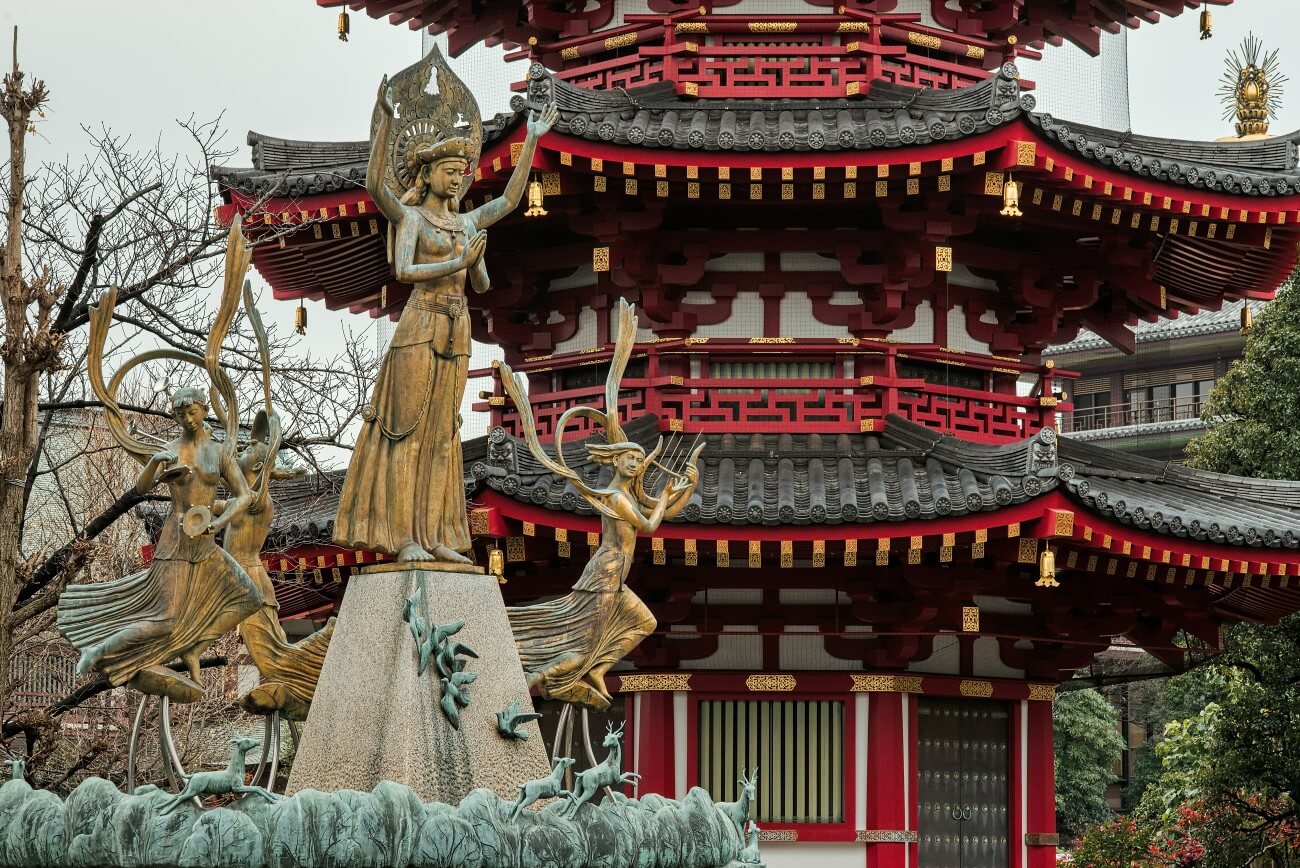
Feel free to download and use this picture in your blog post – it could be a perfect fit for articles about hidden gems near Tokyo, Japanese temples, Kanagawa day trips, and quieter places in Japan that deserve more attention.
With Kawasaki Daishi’s Prayer and Peace statue and rare octagonal pagoda in one frame, this picture captures one of the most memorable corners of the temple. I’m really glad I visited it, and I honestly feel that anyone who loves Japanese temples should consider visiting Kawasaki Daishi too.
How to Use This Image & Attribution
License: CC BY 4.0 — free for personal & commercial use with credit.
- Give credit: “Photo by Luke Lawreszuk – Sprayedout.com” and link back to Kawasaki Daishi Statue and Octagonal Pagoda.
- Do not resell the file as-is or claim authorship.
Copy-paste attribution:
Photo by <a href="https://www.sprayedout.com/">Luke Lawreszuk - Sprayedout.com</a> (CC BY 4.0) via <a href="https://www.sprayedout.com/kawasaki-daishi-statue-pagoda/">Kawasaki Daishi Statue and Octagonal Pagoda</a>.
Free Download
Buy Me a Coffee
FAQs about Kawasaki Daishi Statue and Octagonal Pagoda (Kawasaki, Japan)
What is Kawasaki Daishi in Japan?
Kawasaki Daishi, formally known as Heiken-ji Temple, is a major Buddhist temple in Kawasaki, Kanagawa. It belongs to the Chisan School of Shingon Buddhism and is especially well known for yakuyoke, meaning prayers for warding off evil or misfortune. Its history goes back to 1128, which gives it deep religious importance as well as cultural value for visitors.
What is the Prayer and Peace statue at Kawasaki Daishi?
The sculpture in this picture is known as the Statue of Prayer and Peace (Inori to Heiwa no Zō). It was created by Katsuzō Entsuba in 1984 and was made to honour Kōbō Daishi during the 1,150th memorial anniversary of his death, together with an important ceremonial event at Kawasaki Daishi. Rather than being simple decoration, it is a monument with clear spiritual meaning in the temple grounds.
Why is the pagoda at Kawasaki Daishi unusual?
The pagoda at Kawasaki Daishi stands out because it is octagonal. Most pagodas in Japan have four sides, so the eight-sided design here feels much more unusual. It is also a five-storied pagoda, with the five levels symbolising earth, water, fire, wind and sky, which adds deeper Buddhist meaning to its striking appearance.
What is Kawasaki Daishi famous for?
Kawasaki Daishi is especially famous for yakuyoke, or prayers for protection from misfortune. It is also one of Japan’s best-known places for hatsumode, the first temple or shrine visit of the New Year. During the first three days of the year, the temple is said to receive around 3 million visitors, which shows just how important it is in Japanese religious life.
Is Kawasaki Daishi worth visiting from Tokyo?
Yes, definitely. For many travellers, Kawasaki Daishi feels like a hidden gem near Tokyo — historically important, visually memorable, and often less crowded than better-known temple areas such as Asakusa. It is a great place for people interested in Japanese temples, Buddhist culture, architecture, and day trips that feel meaningful without being too far from the city.
How do you get to Kawasaki Daishi from Tokyo?
One of the easiest ways is to travel to Keikyu Kawasaki Station, transfer to the Keikyu Daishi Line, and get off at Kawasaki-Daishi Station. From there, it is about an 8-minute walk to the temple. That makes Kawasaki Daishi a very practical visit from Tokyo, especially if you want to explore a major temple without planning a long day trip.
Recent Photographs
Ocean Waves Crashing on Rocks at Sunrise in Oarai, Japan
Ocean waves crash over the rocks at sunrise in Oarai, Ibaraki, Japan. I took this [...]
Fall Park Scene with Golden Leaves in Białystok, Poland
Autumn is one of my favourite times to walk through Zwierzyniec in Białystok. In November, [...]
Fryderyk Chopin’s Birthplace in Żelazowa Wola – Free Poland Photo
Fryderyk Chopin's birthplace in Żelazowa Wola, Poland, photographed among the peaceful summer gardens of the [...]
Japanese Vending Machines in Nakaminato – Free Street Photo from Japan
Two bright Japanese vending machines beside a weathered building in Nakaminato, Ibaraki - one of [...]
Tokyo Tower from Shiba Park – Free Tokyo Cityscape Picture
Free Tokyo Tower picture taken from Shiba Park in Tokyo after a rainy morning walk [...]
Nagasaki Peace Statue Photo – Free Picture from Peace Park, Japan
Free Nagasaki Peace Statue photo from Nagasaki Peace Park, Japan. A respectful CC BY 4.0 [...]
Hamarikyu Gardens Tokyo: Old Meets New in a Japanese Garden
A peaceful photo from Hamarikyu Gardens in Tokyo, where a wooden bridge leads across the [...]
Free Yellow Tulips Photo with a Purple Tulip in a Spring Garden
A free colorful tulip image from the Royal Castle Gardens in Warsaw, showing one purple [...]
Beach Sunrise Over the Ocean: Free Seascape Photo from Ishihama, Japan
A peaceful winter sunrise at Ishihama Beach in Hitachi, Ibaraki. I took this photo after [...]
Collections From My Travels
2 Days in Madrid Photography Itinerary: Must-See Spots & Hidden Gems
Madrid, Spain’s vibrant capital, can be explored in just two days—enough to savor iconic landmarks [...]
Beautiful Podlaskie in Poland: Nature Landscape Pictures
Here I share pictures of landscapes, nature photography of places I love. Peaceful, calming and [...]
Whytecliff Park in West Vancouver: Free Pictures & Essential Information
Whytecliff Park - the first Marine Protected Area in Canada. A beautiful outdoor spot in [...]
Pictures of Fireworks in Vancouver: Honda Celebration of Light
Fireworks in Vancouver are amazing! Over millions of people enjoy the Honda Celebration of Light [...]
Day Trip in Tokyo to Mt Takao in Autumn: Pictures from the Hike!
Want to enjoy a great day trip in Tokyo and enjoy a beautiful view of [...]
17 Free Pictures from Kyoto’s Bamboo Grove in Arashiyama District, Japan
When you travel to Japan, Kyoto most probably is one of the most important places [...]
Pictures of Osaka Castle: One of the Most Iconic Landmarks in Japan!
Wonder if you should visit Osaka Castle (Osakajo) in Japan? It's an iconic landmark in [...]
Pictures from Auschwitz-Birkenau Concentration Camp in Poland
The largest extermination and concentration camp in the Third Reich, Auschwitz I and Auschwitz II-Birkenau [...]
How to Get to Auschwitz Concentration Camp from Krakow in Poland
There are many options you can choose from when deciding on how to get to [...]